
GUEST LECTURER : THE DIFFERENCES OF CRIMINAL JUSTICE SYSTEM BETWEEN UNITED STATES AND INDONESIA
Kamis, 25 Februari 2016 - 12:25:39 WIBDibaca: 1134 kali
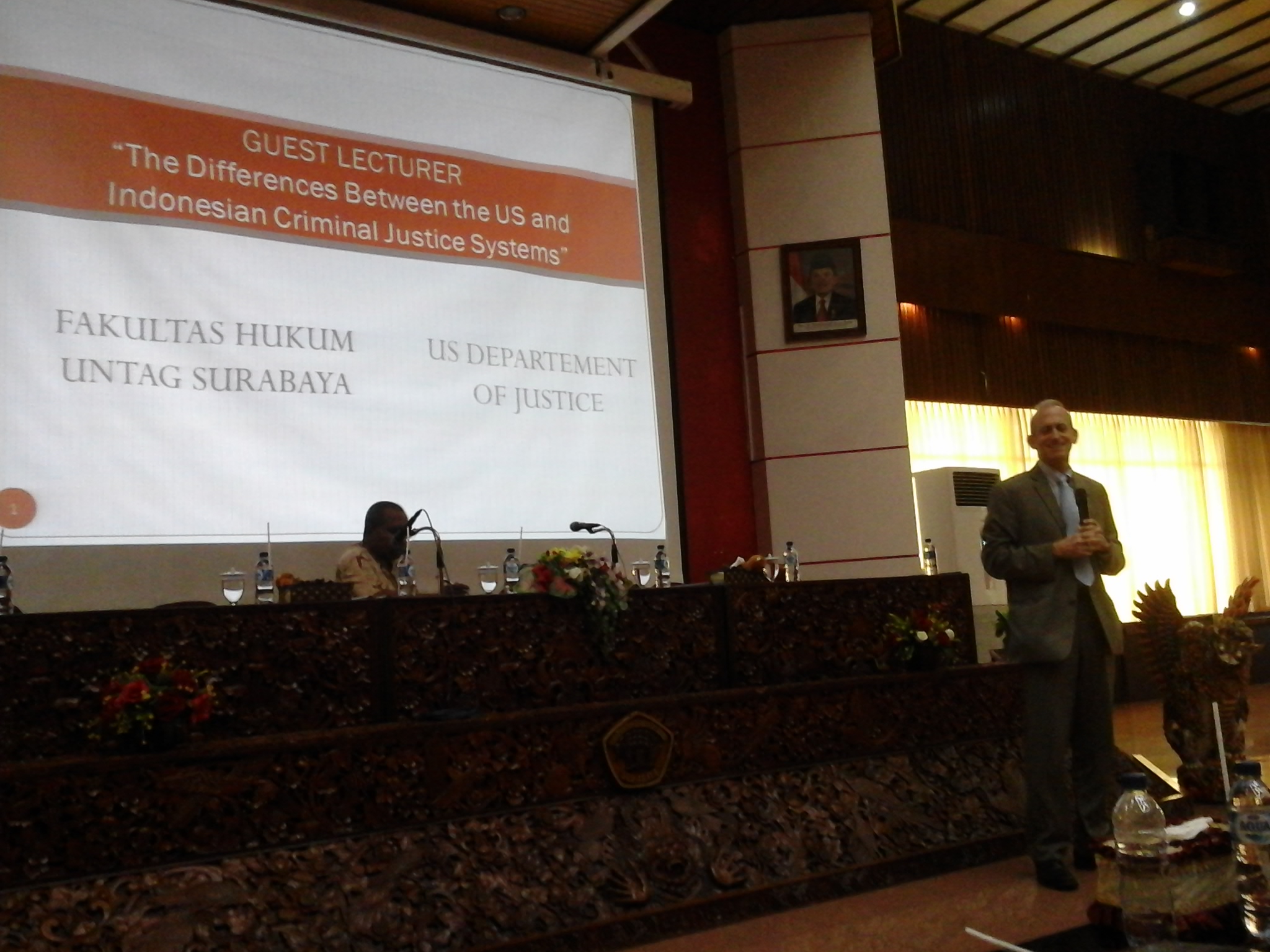
10 Differences Between the US and Indonesian Criminal Justice Systems
Steven Kessler, United States Department of Justice
1. The Investigation Begins.
INDONESIA
-
Suspect formally named as “suspect.”
-
Restrictions on how police may close an investigation.
UNITED STATES
-
No formal designation of the “suspect.”
-
The police can close the investigation whenever they want.
2. The Police Call the Suspect in for Questioning.
INDONESIA
-
One of the first things to be done is to bring in the suspect for questioning.
-
No right to remain silent.
UNITED STATES
-
The police do all they can BEFORE calling in the suspect for questioning.
-
Suspect has the right to an attorney and the right to remain silent.
3. The suspect is kept in custody.
INDONESIA
-
Pre-trial motion to challenge status as a suspect, illegal arrest, and claim that property was improperly taken from him.
-
Who has to prove what?
-
Remedies?
UNITED STATES
-
Defendant brought before judge in 24 hours.
-
Constitutional right to bail being set.
-
Judge decides on custody, not police or prosecutors.
4. Identification Procedures
INDONESIA
-
The defendant can argue at the end of the trial that the identification testimony was weak or that the procedures were unfair.
UNITED STATES
-
Defendant can argue in a pre-trial motion that the identification evidence should be excluded because it was suggestive and unfair.
5. Police Find Physical Evidence During A Search
INDONESIA
-
Improper police procedures are unlikely to result in evidence not being considered.
UNITED STATES
-
Defendant asks to have evidence excluded if it is improperly obtained by police.
-
Court holds a pre-trial hearing to determine the facts.
6. Police Beat Up The Defendant and He Confesses During the Investigation.
INDONESIA
-
The Court will not care too much whether the police beat up the defendant.
UNITED STATES
-
The defendant can challenge and exclude the confession and all of the evidence that was found as a result of the confession – Fruit of the Poisonous Tree.
7. Trial
INDONESIA
-
Panel of three experienced judges decides whether he is guilty or not guilty.
-
Police may or may not show up for trial.
UNITED STATES
-
Jury of 12 ordinary people decide the case.
-
The police always testify and submit to cross-examination.
8. The Defendant Has the Right to Remain Silent at Trial
INDONESIA
-
The defendant’s silence cannot be considered as one of the two pieces of evidence, but still… the accused is expected to make a statement.
UNITED STATES
-
The jury cannot consider the defendant’s silence. But, still, ….
9. The Burden of Proof and the Standard of Proof
INDONESIA
-
The Court can only find guilt if there are at least two categories of evidence giving the judges the internal conviction that the accused is guilty.
UNITED STATES
-
The jury can only find guilt if they unanimously agree there is proof of guilt beyond a reasonable doubt.
10. Direct Appeal to the Intermediate Court
INDONESIA
-
Prosecutor or Defense can appeal, claiming that there is additional evidence or just claiming that the trial court came to the wrong decision.
UNITED STATES
-
Only the defense can appeal.
-
Defense cannot merely claim the jury got it wrong.
-
No new evidence.
-
Was there a procedural error such that the accused was denied a fair trial.
Untag Surabaya || Fakultas Hukum Untag Surabaya || SIM Akademik Untag Surabaya || Elearning Untag Surabaya